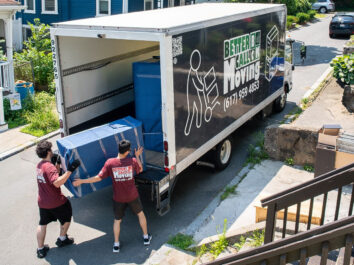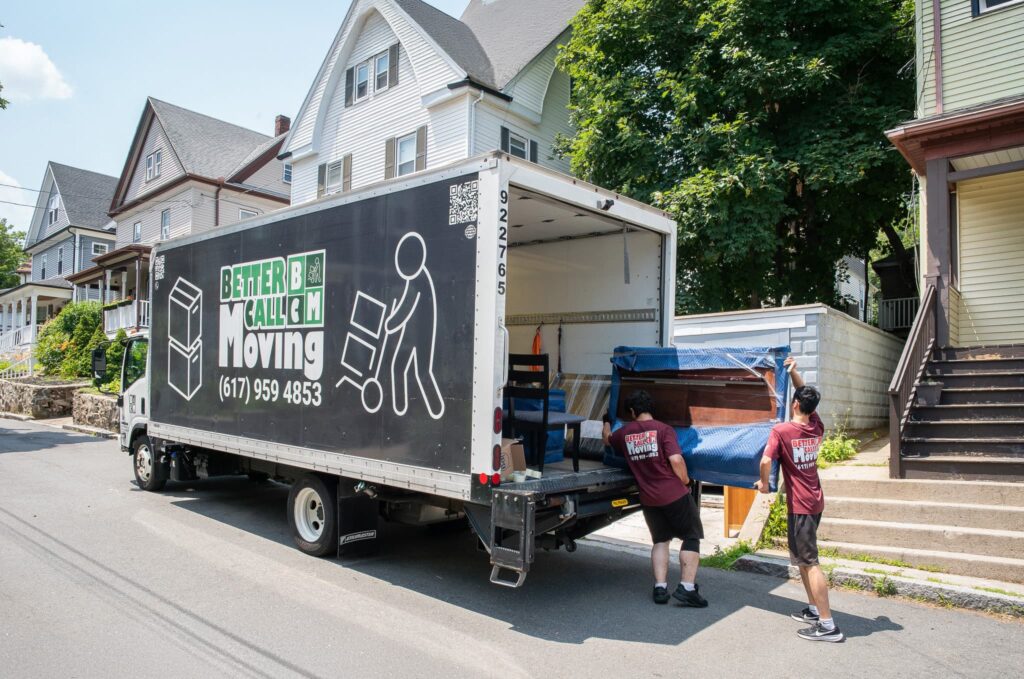
There are plenty of moving companies to choose from, and from the outside many of them look pretty similar. A truck, a crew, some padded blankets, and a promise to get everything from one address to another.
But once the job begins, the differences become much easier to see.
At Better Call Moving, Inc., we believe the quality of a relocation depends on the preparation before the big day just as much as on the work done at the truck. Who answers the first call? Were the right questions asked? Does the crew know what they’re walking into? Is the truck in good condition? Does the company have the proper tools and insurance? And if something changes, is there someone you can talk to?
We handle residential moving, commercial and office relocations, laboratory projects, long-distance moving, packing, and storage. The details differ from job to job, but our basic approach stays the same: understand what the client wants, prepare for it carefully, and take responsibility from beginning to end.
Key Takeaways
| What matters | How Better Call Moving handles it |
|---|---|
| Planning starts on the first call | A sales manager asks about access, parking, elevators, fragile items, storage, and COI needs before the move is booked. |
| Trained, vetted crews | Every mover has completed OSHA 10-hour safety training and passes a background check. |
| Experienced people stay | We aim to pay qualified movers about 25–30% above typical market compensation. |
| Reliable, clean trucks | Modern trucks, generally no more than three years old, inspected before every dispatch. |
| Licensed and insured | MA DPU 25HG39, USDOT 4356476, MC 1755886 — you can check us in the official state and federal databases. |
What to Compare Before You Choose a Moving Company
Online estimates often look alike. These are the questions that actually separate one mover from another — and how we answer them.
| Question to ask any mover | Why it matters | Our answer |
|---|---|---|
| Who plans my move? | Missing details turn into delays on moving day | A dedicated sales manager |
| Are your movers trained and background-checked? | The crew works inside your home or office | OSHA 10 + job training, background checks |
| How old are your trucks? | Breakdowns can cost an elevator reservation or a whole day | Generally no more than three years old |
| Can you provide a COI? | Many buildings won’t let a crew in without one | Yes, coordinated with property management |
| Do you offer storage? | Closings and renovations don’t always line up | Heated warehouse and climate-controlled options |
| Are you licensed? | Unlicensed movers leave you with little protection | Licensed by the MA DPU and registered with FMCSA |
1. Every Project Starts With a Conversation
The first person you speak with at our company will usually be someone from our Sales Department.
We don’t see that first conversation as simply an opportunity to book another job. It’s where the plan starts taking shape.
Our sales managers work with each client individually because no two relocations are exactly alike. Someone leaving a small apartment in Boston doesn’t require the same conversation as a business relocating an office, and neither one should be approached like a laboratory relocation.
So we ask questions.
Which items are going to the new place? What’s the access like? Are there stairs or elevators? Is there parking for a truck close to the entrance? Are there oversized or particularly fragile pieces? Do you want packing help? Will anything go into storage? Does the building require a Certificate of Insurance?
For commercial projects, the list gets longer. There may be loading-dock schedules, building rules, elevator reservations, security procedures, or machinery that calls for special handling.
| Residential move | Commercial or office move |
|---|---|
| Stairs, elevators, and walking distance to the truck | Loading-dock schedules and freight elevator bookings |
| Street parking or a moving truck permit | Building rules, security procedures, after-hours access |
| Oversized or fragile furniture | IT equipment, files, specialized machinery |
| Packing help and storage needs | Schedule that keeps downtime to a minimum |
| Building COI requirements | COI and insurance documentation for property management |

We prefer to learn those details on the phone instead of discovering them after a crew has already arrived.
This kind of communication is something we take pride in. We want people to receive straightforward answers and understand what they’re paying for and how the day is expected to go.
Some callers already have a clear picture of what they want, while others are still figuring it out. Either way is perfectly fine.
Our job is to listen first and then help connect the pieces. If you want to get ahead of those questions, our guide on how to prepare for movers walks through what to have ready.
2. The People Who Show Up Matter
A moving company may spend a lot of money on advertising, but when the day comes, the client isn’t dealing with an advertisement. They’re dealing with the people who walk through the door.
That’s one reason we focus so much on our crews.
Every member of our team has OSHA 10 training, and our employees receive additional instruction related to the actual work they perform. The 10-hour course is part of the federal OSHA Outreach Training Program, which gives workers a grounding in recognizing and preventing common job hazards.
That includes proper packing and wrapping techniques, furniture protection, safe handling, loading procedures, and the use of professional gear.
Moving looks simple until you try to get a large piece of furniture down a tight staircase or through a doorway with very little clearance. Strength helps, of course, but experience and judgment are usually what prevent damage.
Our crew members also go through background checks.
That’s important to us because people are giving our staff access to their homes and businesses. On commercial jobs, employees may be working around computers, documents, devices, and other valuable property.
We know that trust has to extend beyond the company name to the people doing the work.
Pro Tip: Whichever mover you hire, ask two direct questions before booking: “Do your crews have formal safety training?” and “Are your movers background-checked?” A confident, specific answer is a good sign. A vague one is worth noting.

3. Good Employees Are Worth Keeping
Employee turnover is a real issue in our industry. We try to approach it differently.
Our goal is to pay qualified professionals approximately 25–30% above typical market compensation for comparable positions in the moving industry.
There is a practical reason behind that decision.
Good movers are difficult to replace.
An experienced employee knows how to protect furniture without wasting time. He looks at a difficult staircase or doorway and thinks the job through before lifting anything. He understands how to load a truck so items remain secure in transit. Just as importantly, he knows how to communicate with the client and the rest of the crew.
We prefer to invest more in people who treat the job with care and give them a reason to stay with the company.
That experience eventually comes back to you in the form of a smoother result.
4. We Give Our Trucks the Same Attention
A truck isn’t just transportation. For several hours — or sometimes several days — it may contain most of what a family or business owns.
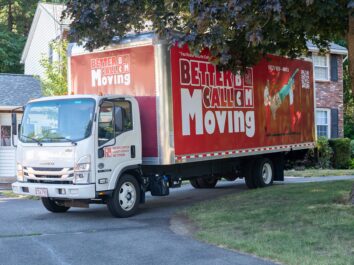
Our moving trucks are modern and are generally no more than three years old.
We maintain our vehicles and check their condition before dispatch because an unreliable truck quickly turns into your problem.
Imagine having an elevator reserved from 9:00 to 11:00 and the truck doesn’t make it. Or having employees waiting at a new office while their furniture is sitting somewhere because of a preventable mechanical issue.
With long-distance moving, reliability becomes even more important. A truck leaving Massachusetts for New York, Florida, or another state may cover hundreds or thousands of miles — our Boston to NYC moves are a good example.
No transportation company is able to honestly say mechanical problems are impossible. Our part is to use newer vehicles, keep them well maintained, and inspect each one before it leaves the yard.
Our trucks are also equipped with modern safety features, including cameras and backup cameras.
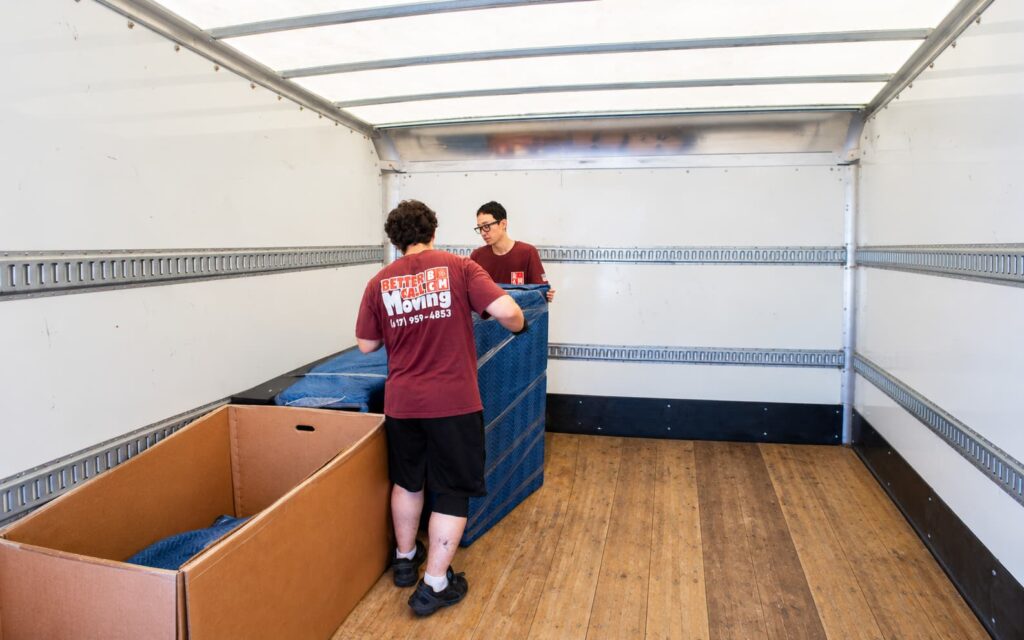
And we keep the cargo areas clean.
It seems basic, but if your mattress, sofa, boxes, or office furniture is going into a truck, you shouldn’t have to worry about dirt or unpleasant odors left from a previous job.
| Truck standard | What it means for you |
|---|---|
| Generally no more than three years old | Lower risk of breakdowns on moving day |
| Checked before every dispatch | Problems are caught in the yard, not on the highway |
| Cameras and backup cameras | Safer maneuvering on narrow streets and at loading docks |
| Clean cargo area | No dirt or odors on your mattress, sofa, or boxes |
5. Proper Tools Prevent a Lot of Problems
Good crews still need the right tools.
Depending on the job, our team works with padded blankets, dollies, carts, straps, wrapping materials, floor protection, and other professional gear.
We don’t approach every item the same way.
A glass table calls for different preparation than a sofa. A large conference table presents a different problem from a filing cabinet. Laboratory instruments may have handling requirements that don’t apply to either one.
| Item | Typical protection |
|---|---|
| Sofa or upholstered chair | Padded blankets and stretch wrap |
| Glass table or mirror | Extra padding, careful securing in the truck |
| Conference table | Disassembly where possible, blankets, straps |
| Filing cabinet | Dolly, straps, drawers secured |
| Floors, walls, doorways | Floor protection and padding along the path |
This is where training and tools have to work together.
It’s easy to wrap something in a blanket. Knowing where additional protection is required, how to secure an item inside the truck, and how to carry it safely through a building takes more experience.
For us, protecting your property also means protecting everything around it — the floors, walls, doorways, elevators, and other areas our crews work in.
Pro Tip: Packing yourself? Use sturdy boxes in a few standard sizes so they stack securely in the truck. You can order packing supplies from us and have them dropped off before the move.
6. Commercial Moving Is About More Than Furniture
A commercial relocation has a different kind of pressure.
When a family relocates, the goal is to make the process as smooth as possible. When a business relocates, there is another concern: how quickly will everyone get back to work?
That’s why we spend time planning commercial moving and office relocation projects.
Before the big day, we want to understand access at both locations, parking and loading conditions, elevator availability, building restrictions, the amount and type of equipment involved, and the schedule the business has to maintain.
Commercial buildings also commonly have insurance requirements.
Our company maintains the insurance coverage and documentation required for the commercial work we undertake. When necessary, we coordinate applicable insurance documentation, including a Certificate of Insurance (COI), with building or property management.
These aren’t things we want to figure out while a crew is waiting outside.
The more we handle beforehand, the less time gets wasted once the trucks arrive.
Q: What is a Certificate of Insurance (COI), and why does my building want one?
A: A COI is a document from the moving company’s insurer that confirms the mover carries liability coverage. Many office buildings, condos, and managed apartments require one before a crew can use the loading dock or elevator. Send us your building’s COI requirements in advance and we’ll coordinate it with property management.
Planning an office or commercial move? Tell us about your timeline and building requirements, and our team will build a plan that keeps downtime to a minimum.
Book a Move →
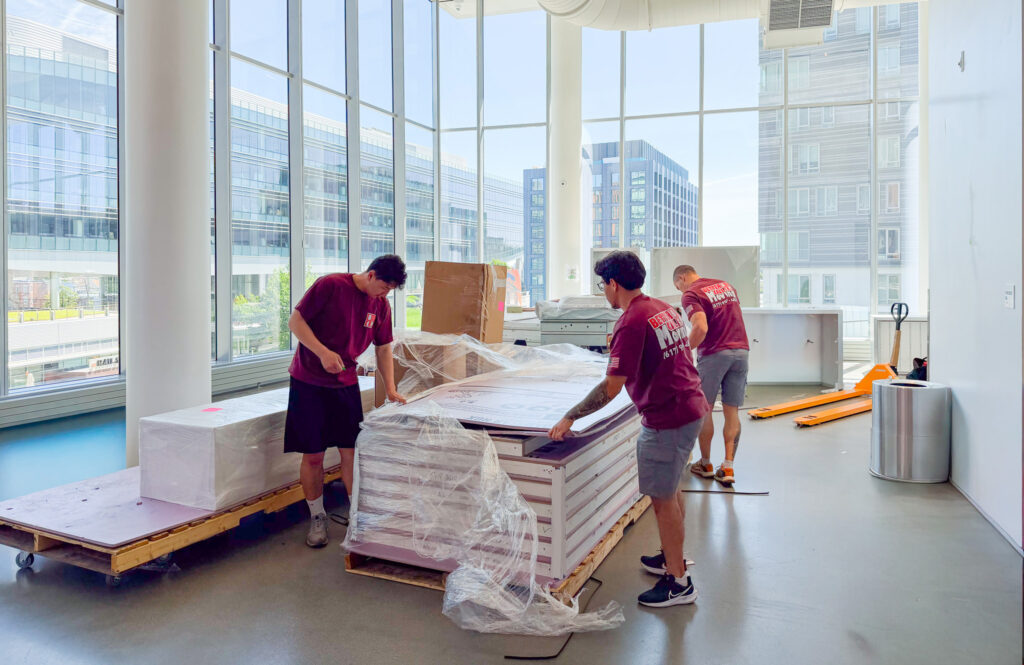
7. Laboratory Moving Requires Its Own Plan
Laboratory and biotech relocation is one area where we don’t like assumptions.
Lab equipment is often sensitive, heavy, fragile, expensive, or all four at the same time. Some instruments may be handled by our professional crew, while others may require special preparation or a specialized vendor.
That has to be established before anything gets picked up.
For a laboratory project, our first priority is understanding exactly what is being transported and what requirements come with it.
We may discuss access, dimensions, weight, handling instructions, manufacturer requirements, or the involvement of other contractors.
If something falls outside the scope of standard services, we prefer to identify that early and coordinate the correct approach.
Speed matters on a commercial project, but not at the expense of doing something incorrectly.
With specialized instruments, preparation usually saves far more time than rushing.
8. Client Service Doesn’t End After the Sale
We don’t want the relationship to change once the job is booked.
The Sales Department may start the conversation, but communication has to continue through planning, operations, the day itself, and final delivery.
Plans change. Anyone who has been in this business long enough knows that.
A closing gets delayed. A building changes an elevator reservation. A family suddenly requires storage. A business realizes it has more equipment than originally expected.
In that case, our first question is usually: What can we reasonably do to make this work?
We won’t promise that every last-minute request will be possible, and we don’t think a responsible company should make that promise. But we do make an effort to find a practical solution.
The same applies to scheduling.
Arrival times matter to us, and significant delays are uncommon for our crews. Traffic, weather, emergencies, and other unexpected situations occur in transportation, but your time still matters.
If something changes, communication matters even more.
A short, honest phone call often keeps a small problem from growing into a big one. And once the truck is unloaded, our checklist of what to do after your movers finish helps you close out the move.
9. Moving and Storage Sometimes Have to Work Together
Not every job goes directly from Point A to Point B.
A homeowner may sell a house before the new one is ready. Renovations may run longer than expected. A company may have to vacate one office before construction is complete at the next location.
That’s why moving and storage is an important part of our services.
We have access to secure, heated warehouse storage for anyone whose belongings have to be held between pickup and delivery.
We also work with storage facilities and arrange climate-controlled solutions when appropriate. Businesses can also use our commercial warehousing for inventory, furniture, or equipment between locations.
Not everything has the same storage requirements.
Household furniture may call for one type of environment, while certain business or specialized items may demand specific temperature, humidity, security, or other conditions.
| Situation | Storage option to discuss |
|---|---|
| Sold the house before the new one is ready | Secure, heated warehouse storage between pickup and delivery |
| Renovation running late | Short-term storage with scheduled redelivery |
| Office vacated before the new space is finished | Commercial warehousing for furniture and equipment |
| Temperature- or humidity-sensitive items | Climate-controlled storage arranged in advance |
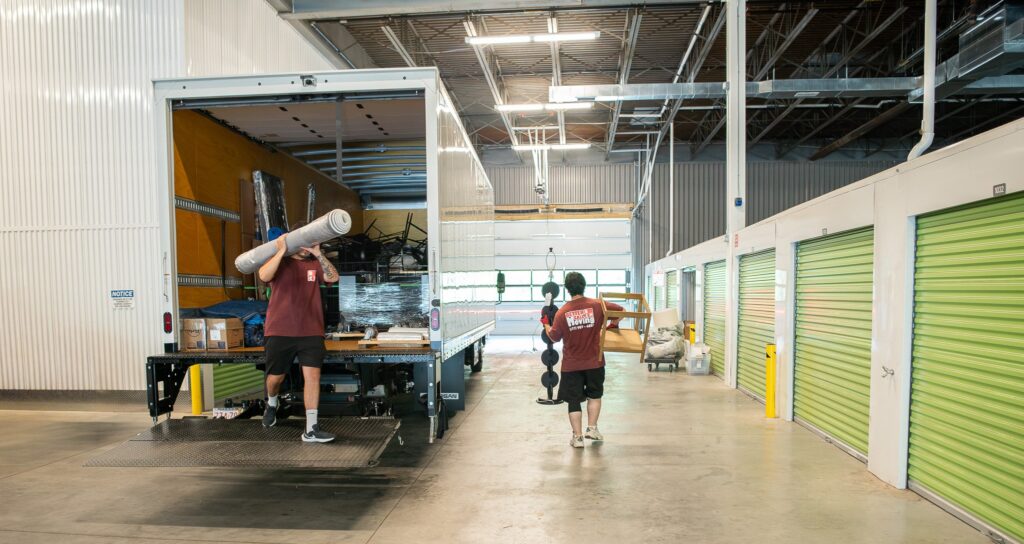
If there are special requirements, we want to know about them beforehand.
Storage should feel like part of the plan, not an emergency solution somebody starts looking for after the truck is already loaded.
How to Check Any Moving Company Before You Book
Our standards only mean something if you can verify them. Before booking any mover — including us — check that the company is properly licensed.
| Credential | Better Call Moving | Where to check |
|---|---|---|
| Massachusetts DPU license (moves within MA) | MA DPU 25HG39 | DPU-regulated moving companies |
| USDOT number (interstate moves) | USDOT 4356476 | FMCSA registered mover search |
| Motor carrier number | MC 1755886 | FMCSA registered mover search |
Moves within Massachusetts are regulated by the state Department of Public Utilities, while moves that cross state lines fall under the Federal Motor Carrier Safety Administration. The FMCSA also publishes a list of red flags of moving fraud worth reading before you sign anything.
10. What We Want Our Clients to Take Away
We provide residential moving, commercial and office relocation, laboratory services, long-distance transport, packing, and storage, but we don’t expect anyone to choose us simply because we offer a long list of services.
What matters is how those services are delivered.
It begins with a sales manager who takes the time to understand the job.
Then somebody has to turn that conversation into a workable plan. The crew has to arrive prepared. The truck has to be clean and reliable. Proper tools have to be on site. Furniture and property have to be protected. Commercial insurance requirements have to be handled. And if storage is required or the schedule changes, somebody has to help figure out what comes next.
That’s the part of the business people don’t always see when they’re comparing estimates online.
We invest in our employees and training because the people doing the work matter. We pay qualified movers above typical industry compensation because we want good employees to stay. We invest in newer trucks and professional gear because reliability and safety matter. And we focus heavily on communication because even a technically good job turns into a bad experience when nobody knows what’s going on.
We aren’t interested in telling people that every move will be perfect. Relocation involves buildings, traffic, weather, schedules, people, and sometimes circumstances nobody controls.
Our own preparation and the way we respond, however, are fully in our hands.
Whether you’re moving a family across town with our local movers, relocating a company, transporting laboratory instruments, placing belongings in temporary storage, or planning a long-distance trip from Massachusetts, we want the experience to feel organized from the first conversation through the final delivery.
That’s the standard we’re continuing to build at Better Call Moving, Inc.
At the end of the day, a slogan is not what we want people to keep in mind.
We want them to recall that we showed up prepared, took care of their property, communicated clearly, and did the job right.
Ready to plan your move? Talk to our sales team about your home or business move in Boston and Greater Boston — and see why customers trust our Boston movers.
Get Your Free Quote →
Frequently Asked Questions
What makes Better Call Moving different from other moving companies?
Preparation. Every move starts with a sales manager who learns about access, parking, fragile items, storage, and building requirements before moving day. Our crews have OSHA 10 safety training and pass background checks, our trucks are generally no more than three years old, and we coordinate COIs and insurance documentation for commercial buildings.
Is Better Call Moving licensed and insured?
Yes. We are licensed by the Massachusetts Department of Public Utilities (MA DPU 25HG39) and registered with the FMCSA (USDOT 4356476, MC 1755886). We maintain the insurance coverage and documentation required for the work we take on, including Certificates of Insurance for buildings that require them.
What types of moves does Better Call Moving handle?
Residential moves, commercial and office relocations, laboratory projects, long-distance moving, packing, and storage. For specialized lab equipment, we confirm handling requirements in advance and coordinate with specialized vendors when needed.
Can you store my belongings between move-out and move-in?
Yes. We have access to secure, heated warehouse storage and can arrange climate-controlled storage when items require it. Tell us about storage needs when you book so it becomes part of the moving plan.
What happens if my moving date or plans change?
Contact your sales manager as soon as you know. Closings get delayed and buildings change elevator reservations — we’ll look for a practical solution. We can’t guarantee every last-minute request, but early communication gives us the best chance to adjust the plan.
Recommended Reading